

One trench coat. One group of friends. One door they weren’t allowed through. That’s where MUF10 began.
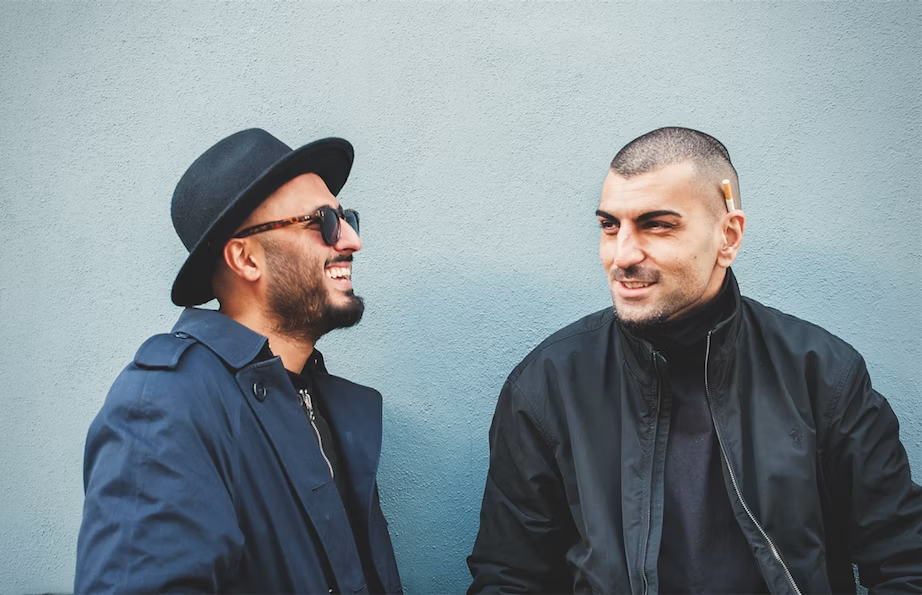
There’s a moment that explains everything about MUF10.
Sivas, one of the biggest Danish rappers of his generation had just performed a sold-out concert at a Copenhagen club called Sunday. The following weekend, he and his friend Reza Etamadi joined the queue outside the same club. They could hear Sivas’ music playing inside. They were turned away at the door.
That specific feeling, being looked at and immediately dismissed, while your culture plays on the other side of the wall, is where this brand comes from.

Reza grew up in Nørrebro and Brøndby Strand, two of Copenhagen’s roughest neighbourhoods, having arrived from Iran at the age of six. He and his friends knew the door well. But at some point they discovered something, a trench coat worked like an invisibility cloak on club pickers. Put one on and suddenly you belonged. So they got hold of one between all of them. One person would get in, a girl would walk out with the coat, pass it along, and one by one the whole group would make it through the door wearing the same jacket.
That image, friends sharing a single trench coat outside a nightclub just to be let in became the entire philosophy of MUF10. The idea that the right piece of clothing could open a door that would otherwise stay shut. That what you wear has real, tangible power over how the world treats you.
He even named one of his early collections after it. Vi kan ikke komme ind. We can’t get in.

When MUF10 launched in 2014, it wasn’t subtle. Reza had been styling his friend Sivas, fresh off his breakthrough hit D.A.U.D.A and put him in MUF10 from the start. Before most people even knew the brand existed, they already wanted in. The hoodies were hard to get. That was very much the point.
Then Copenhagen Fashion Week happened. The oversized “Familie før Para” bomber jackets, Family before Para, a nod to the Bandidos gang became the most photographed pieces of the entire week. The editors of Costume and Woman were wearing them. And then American Vogue called.
An Iranian man from the ghettos of Copenhagen, getting a call from American Vogue because his bombers had taken over fashion week. That is what happens when a brand comes from a real place.
What followed was a run that most brands never get close to. Kendrick Lamar photographed in a MUF10 Maersk sweatshirt on his European tour. Young Thug wearing a dress-like wetsuit suit Reza made for him in Copenhagen. Legal letters from Maersk that Reza forwarded straight to his lawyer without finishing reading. Production in the same factory as Gucci. Stocked at Harvey Nichols, Antonia Milan, Birger Christensen.
And then in 2018, days after Denmark passed its face covering ban. Reza sent hijabi models down the runway and ended the show with niqab-wearing women handing flowers to models dressed as police officers. It was covered globally. Because in a world of polished Scandinavian minimalism, MUF10 was the only brand saying something out loud.

In March 2021, MUF10 was declared bankrupt. The gap between creative ambition and business infrastructure, the thing that kills so many independent labels had caught up with them.
But a failure? Not even close.
The full story, the trench coat, the Vogue call, the Kendrick moment, the runway protest and everything in between, is in the video below.